
Charlevoix County Arrest Records and Court Charges
A Charlevoix County arrest record is the account of an arrest itself. It notes who made the arrest, when it happened, and the booking that followed at the county jail. Local police and sheriff's deputies handle arrests across the county. The record of that custody event, including booking data, lives on the law enforcement and jail side. An arrest alone does not set the charges. In Michigan the elected prosecutor reviews the case and decides which formal charges to file. Christopher "Kit" Tholen serves as the county Prosecuting Attorney, with Greg Weston as Chief Assistant. Once charges are filed with the court, they become the court charge record that follows the case.
The two records answer different questions. The arrest and booking side tells you that someone was taken into custody and held. For the jail roster and booking detail, the Charlevoix County inmate records page is the right stop. The court charge record tells you what the State formally accuses the person of doing. It lists each charge, the statute behind it, and the current status. Court charges after an arrest are tracked through the case file from the first hearing to the final outcome. The full case history, pleas, and sentence appear in the Charlevoix County criminal court records.
How to Find Charlevoix County Arrest Records
Charges and their status show up in the court case index, not on a mugshot page. The county's first stop is the countywide document portal, which is county branded but vendor hosted. For statewide visibility, Michigan runs a case-search site that covers courts across the state. Arrest and booking detail is not held in these court portals. That part sits with the sheriff and the jail, and older or unposted records come through a public-records request.
- Open the Charlevoix County document portal and choose a search mode.
- Search by a party name or a case number.
- Open the matching case and read the full charge list.
- Check each charge for its statute code, level, and current status.
When a charge or booking record is not posted online, the sheriff's office takes a written request through its Freedom of Information Act form. If the county portal comes up empty, the Michigan case-search site is the statewide backup.
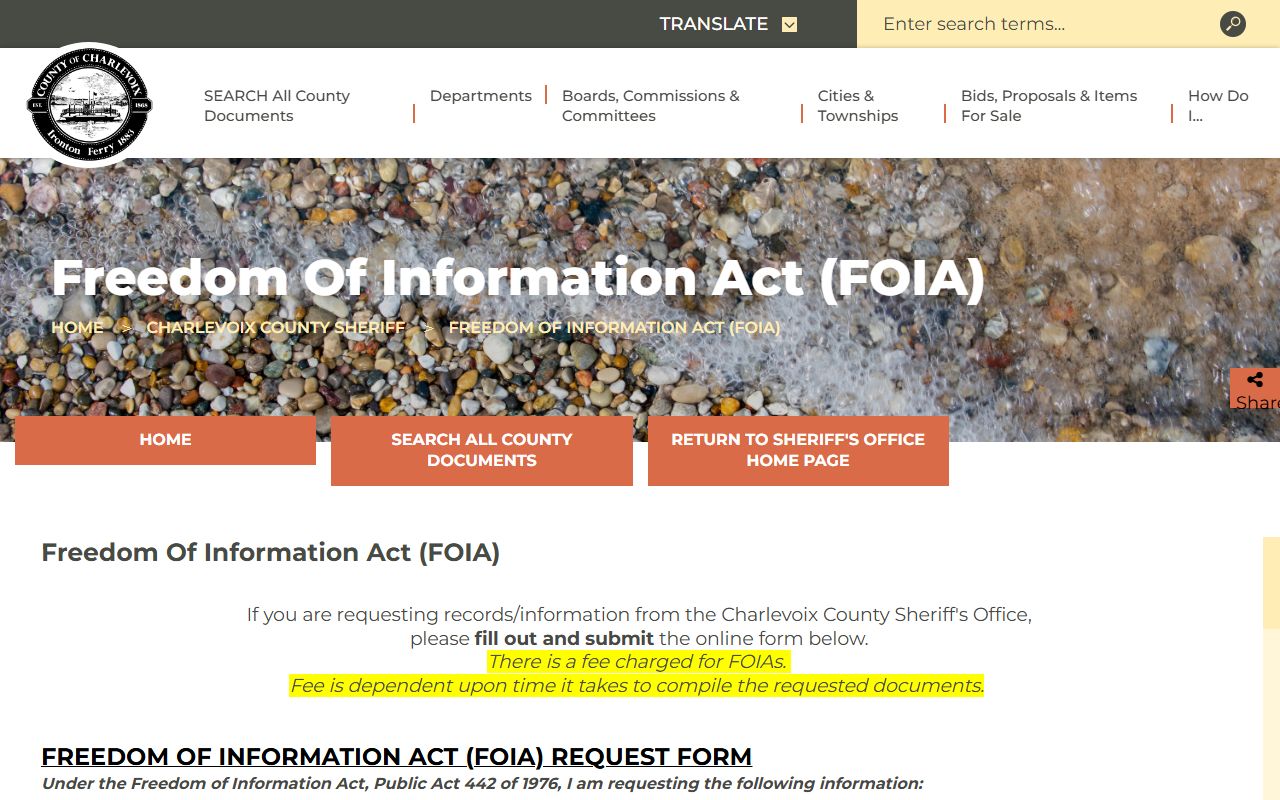
The form routes law-enforcement records to the sheriff's FOIA coordinator, which is often the practical path for older arrest paperwork. Court charges, by contrast, stay with the court clerk and appear in the case index.
Charlevoix County Charging Documents After Arrest
The court charge record begins when the prosecutor files a charging document. Police request a warrant, the prosecutor reviews it, and the charge issues from there. Michigan uses three main charging documents. Which one appears depends on how serious the offense is and which court hears the case.
Serious cases often start with investigators building the file first, and the sheriff's detectives division handles much of that work.
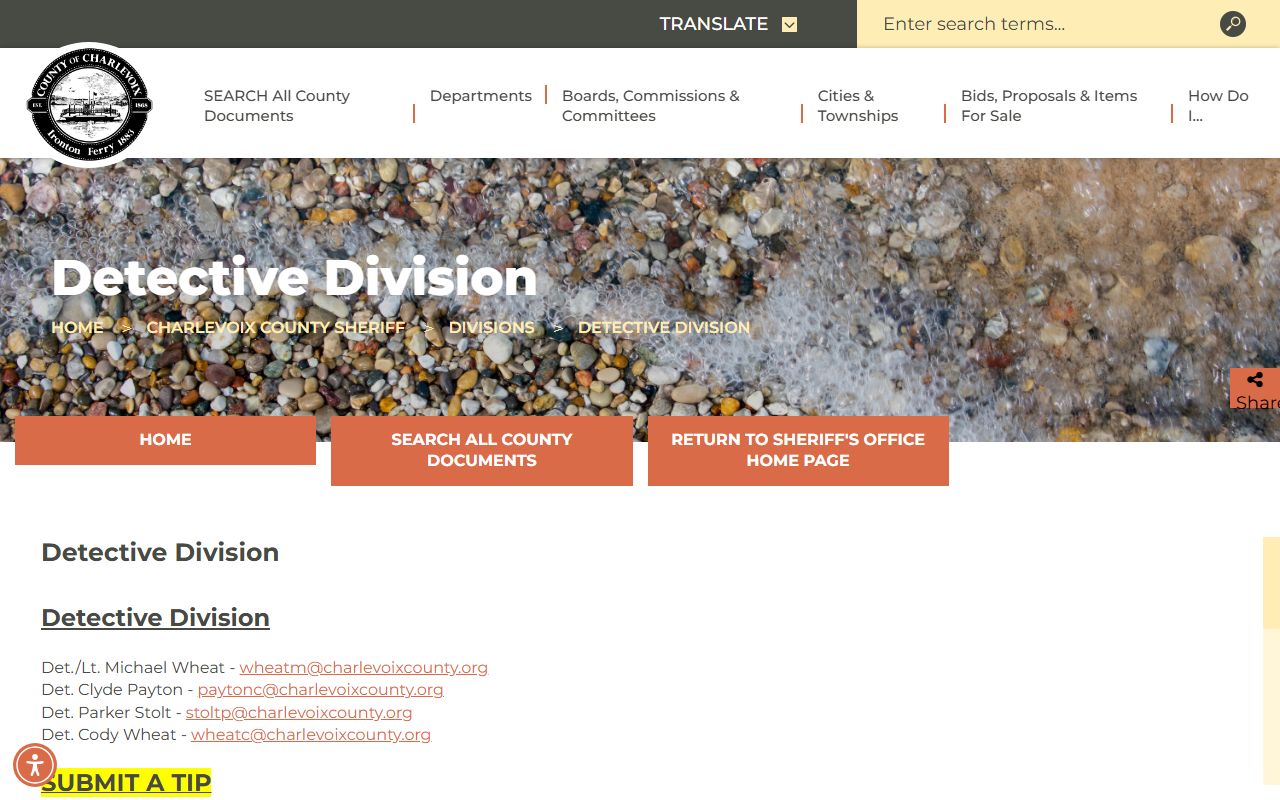
Their reports feed the prosecutor's charging decision before any document reaches the court clerk. The table below sorts the three document types by who files them and when.
| Complaint | Information | Indictment | |
|---|---|---|---|
| Filed By | Officer / Prosecutor | Prosecutor | Grand Jury |
| Common For | Misdemeanors | Many felonies | Serious felonies |
| Starts | The case | The case | The case |
In Charlevoix County, most felonies move forward by information after a district court preliminary exam. Grand jury indictments are uncommon here. The 90th District Court handles misdemeanor complaints, while the 33rd Circuit Court takes felony charges.
A felony charge does not go straight to trial. The district court first holds a preliminary examination to test probable cause. If the judge finds enough evidence, the case binds over to the circuit court. From there, the felony information carries the formal charges through arraignment and beyond. The prosecutor's office notes that most criminal cases begin with this warrant and charging review.
Charge Status in Charlevoix County Records
Charges rarely stay frozen. As a case moves, a charge can be amended, reduced, added, dropped, or dismissed. The docket uses short status words to track each change. Reading them correctly keeps an arrest record in context.
The sheriff's forms page collects the requests residents file around a case, from records to victim services.
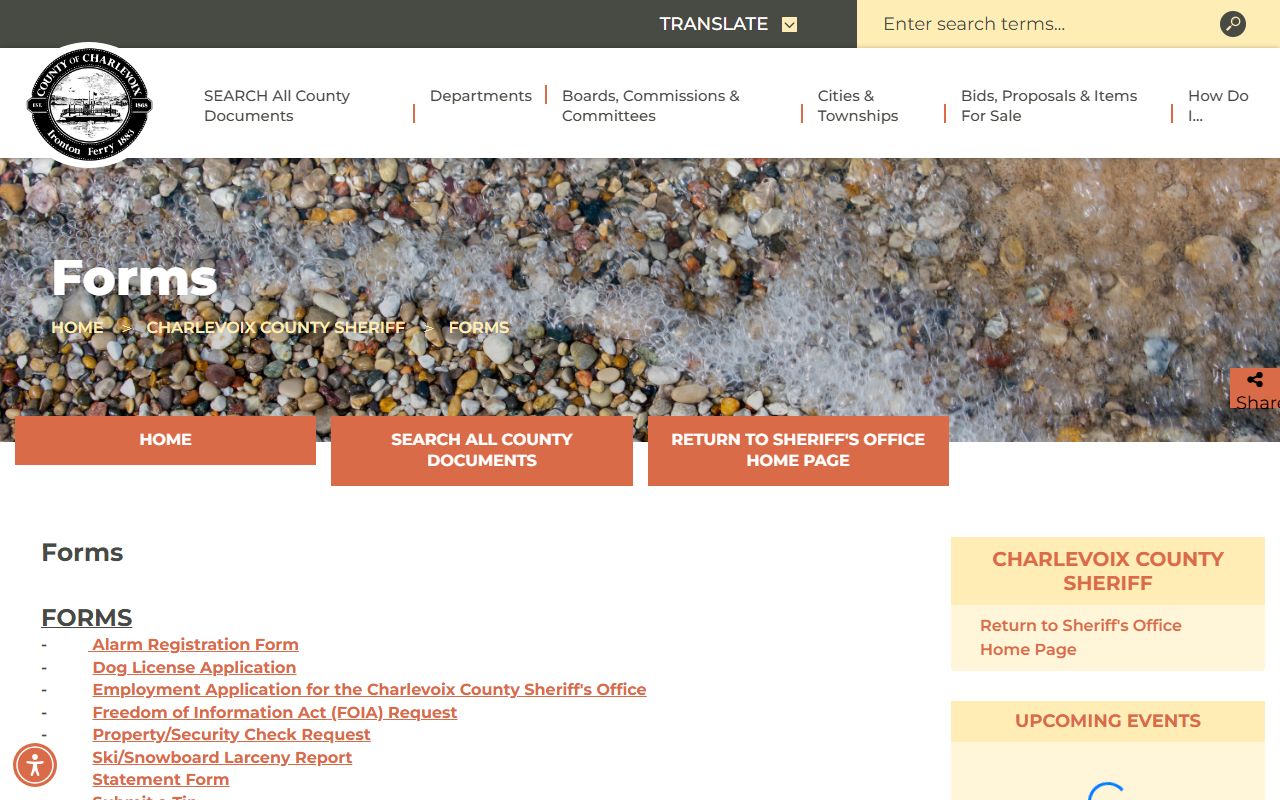
None of those forms change a charge, but they show how the office routes paperwork tied to an arrest. The charge status itself lives on the court docket, using the terms below.
| Status | What It Means |
|---|---|
| Pending | The charge is filed and the case is still open, with no plea or verdict yet. |
| Amended / Reduced | The prosecutor changed the charge, often to a lower level or a different statute. |
| Dropped | The prosecutor withdrew the charge before the case was resolved. |
| Dismissed | The court ended the charge, with or without the option to refile. |
| Nolle Prosequi | A formal notice that the prosecutor will not pursue the charge further. |
Charges vs. Convictions
Being charged is not the same as being convicted. A charge is an accusation that rests on probable cause. A conviction comes only after a plea or a verdict that meets a much higher bar. Both can appear in public records, so the difference matters when reading an arrest record.
| Charge | Conviction | |
|---|---|---|
| Stage | Accusation | Verdict or plea |
| Burden of Proof | Probable cause | Beyond reasonable doubt |
| Public Record | Yes | Yes |
A charge on an arrest record does not prove guilt. Michigan treats every defendant as innocent until a court says otherwise. The prosecutor carries the burden the whole way. Even a felony charge can end in a dismissal, a reduced plea, or an acquittal. That is why the charge status field matters as much as the charge itself when reading a record.
Sealed vs. Expunged Records
Some charge records leave public view. Michigan law lets eligible convictions be set aside, and courts can seal certain files. Sealed and expunged are not the same, and each follows its own rule.
| Sealed | Expunged | |
|---|---|---|
| Visibility | Hidden from public | Treated as never filed |
| Law Enforcement | Limited access | Very limited |
| Eligibility | By court order under MCR 8.119 | Eligible convictions under MCL 780.621 |
Michigan's set-aside law, MCL 780.621, lists which convictions qualify and how many a person can clear. A clean-slate provision now sets aside some eligible records without a petition. Sealing under MCR 8.119 is a separate court decision that makes a file nonpublic.
Charge Codes and Severity Levels
Every charge ties back to a statute. The code on the docket points to the exact law the prosecutor cited. Michigan sorts offenses into felonies, misdemeanors, and civil infractions. District court hears misdemeanors and traffic matters, while circuit court hears felonies. A single arrest can still produce several separate charges, each with its own code and level.
Misdemeanors carry their own levels too. Some cap jail time at 93 days, while others reach a full year. High-court misdemeanors can carry up to two years and route to circuit court. The 90th District Court also keeps a fine sheet for common civil infractions, from speeding to equipment violations. Those infractions are not crimes, so they do not become a criminal charge record.
Traffic crashes can sit behind some charges, and the sheriff posts an accident reports process for those incidents.
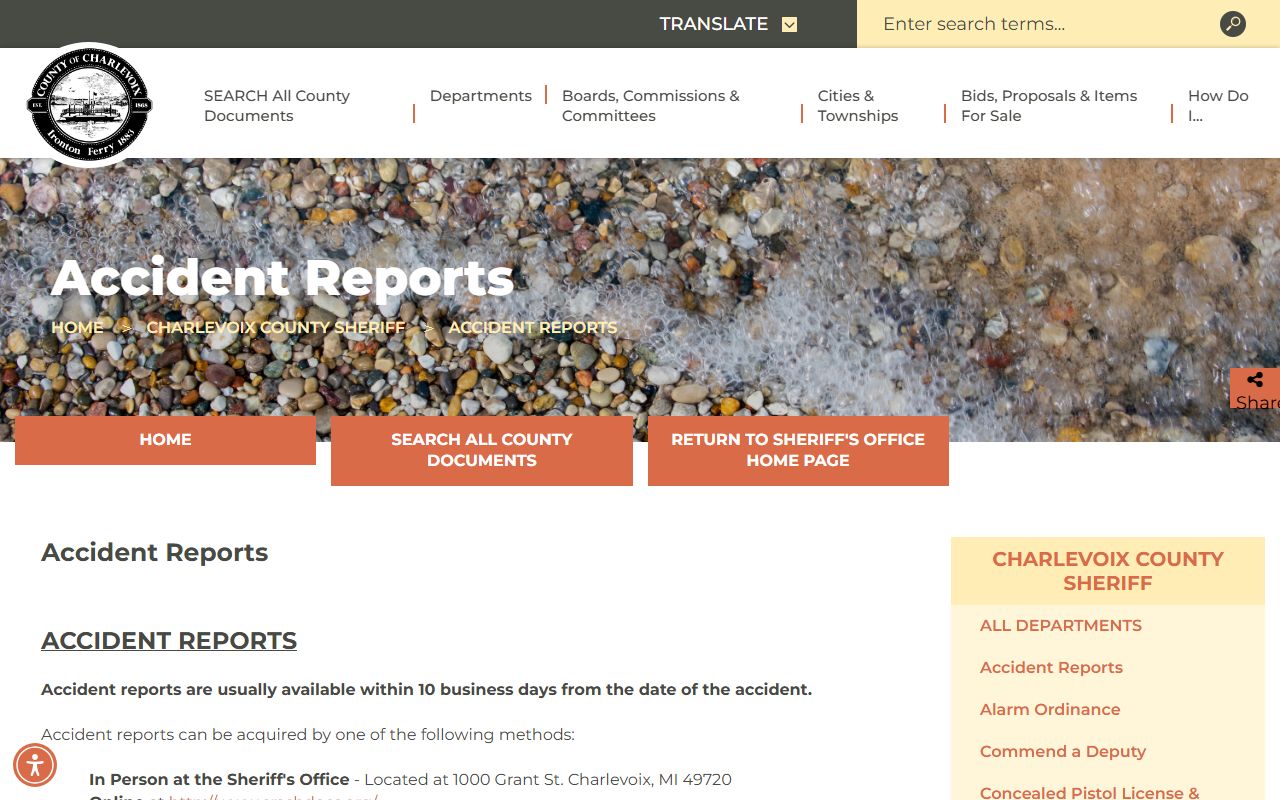
An accident report is not a charge, but it can support one when a crash leads to a citation or a criminal count. The charge code on the docket is what tells you the level and the statute involved.
Statewide Charge and Criminal History Lookups
County files show local charges, but a person's history can stretch across Michigan. The Michigan Department of Corrections runs the Offender Tracking Information System, known as OTIS. The OTIS database lists people in prison, on parole, or on probation under state supervision. It is the statewide layer above a single county court file.
OTIS does not replace the court record. For the charges as filed and their status, the court case index remains the source. For custody status, the county jail and OTIS cover different stages of the same system. Note: OTIS reflects state-level supervision, so a purely local misdemeanor arrest may never appear there at all.
Requesting Charlevoix County Arrest Records
Arrest and incident paperwork that is not online comes through the sheriff. The Charlevoix County Sheriff's Office takes written public-records requests for law-enforcement files. Those requests route to a dedicated FOIA coordinator for law-enforcement records, separate from the county clerk's general FOIA channel.
Charlevoix County Sheriff's Office
Law Enforcement FOIA Coordinator: Kirk Raymond
1000 Grant St.
Charlevoix, MI 49720
231-547-4461
Administration: Monday to Friday, 8:00 to 5:00
General questions can start at the sheriff's contact page, which lists the main office and the Beaver Island and Boyne Falls substations.
Booking and custody questions go to the jail, while formal records requests go to the FOIA coordinator. Charge questions, on the other hand, belong to the court clerk who keeps the case file.
Charlevoix County Background Check Notes
A casual name search is not a background check. Formal background checks for jobs, housing, or credit fall under the Fair Credit Reporting Act. Those reports must meet strict accuracy and consent rules that a quick public lookup does not.
The sheriff also runs prevention work, and its community safety programs page lists services like free drug-test kits.
Those programs sit outside the records system, but they show the office does more than make arrests. A public arrest record still calls for careful reading, since a charge is only an accusation.
Important: Charlevoix County Court Records is not an FCRA-regulated consumer reporting agency, so its data cannot be used for hiring, housing, or credit decisions.
Restricted Charge Records in Charlevoix County
Not every charge record stays open. Juvenile cases are the biggest limit. Under MCL 712A.28, juvenile records open only to people with a legitimate interest or by court order. Sealed files and expunged convictions also drop from ordinary public view.
Dismissed charges may still appear unless a court removes them. Active investigations can stay closed while work continues. When a record is not public, the clerk, the court, or the sheriff's FOIA coordinator explains which access rule applies.