
What Is a Court Docket in Charlevoix County
A docket is the court's running list of everything that happens in a case. Each line on it is a docket entry. The entry shows the date, the event, and the paper that was filed. Michigan courts also call this the register of actions. Think of it as a table of contents for the case file. The docket does not hold the full text of every motion or order. It points to them instead. Read a Charlevoix County docket to see the sequence of a case, from the first complaint to the final judgment.
Both trial courts in the county keep dockets, and so does the Probate and Family Court. Entries carry short status words that mark the stage of a case. You will see pending, open, disposed, closed, and sentenced. A civil claim may read pending while it waits for trial. A criminal case may read sentenced once the judge rules and closes it. These words tell you where a matter stands without opening the full file. That is why the docket is often the fastest way to check a case.
Court dockets are public in Michigan unless a statute, rule, or order makes them private. Access follows the Michigan Court Rules rather than the ordinary open-records process.
Which Courts Publish Charlevoix County Dockets
The county's courts sit in a fixed order. At the top are the Michigan Supreme Court and the Court of Appeals. Below them, felony and higher-dollar civil cases move through the 33rd Circuit Court, while traffic, misdemeanor, and small-claims matters go to the 90th District Court. The Probate and Family Court handles wills, estates, guardianships, and juvenile files. Each trial court keeps its own docket, but not every court posts a deep, searchable version online.
The circuit court posts its schedule on the county's court dockets page.
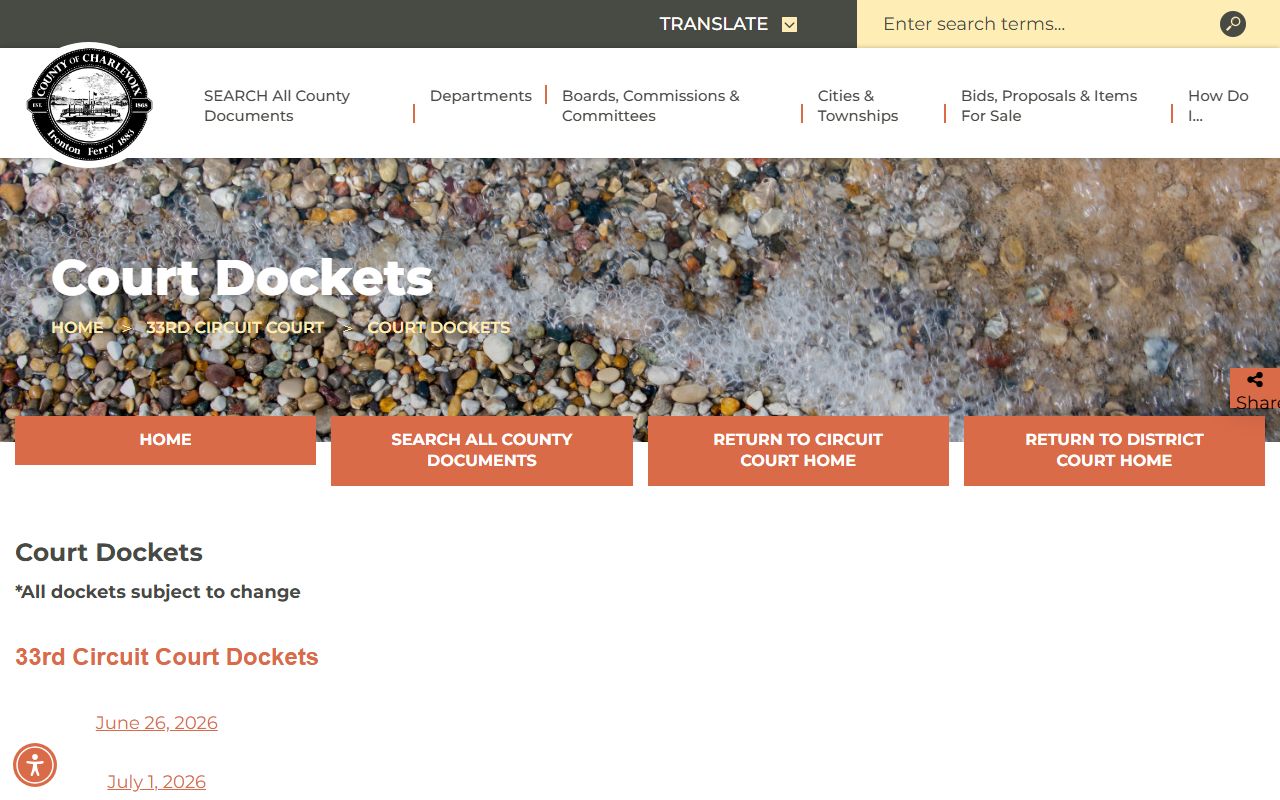
That page is short and calendar-style. It lists docket dates for the circuit court and for the Friend of the Court referee, not a searchable list of parties or case numbers. Here is how the county's docket sources break down.
- 33rd Circuit Court: felonies, civil claims over $25,000, and domestic relations, shown on a brief docket-date calendar.
- 90th District Court: traffic, misdemeanors, landlord-tenant, and small claims, with a thinner online docket path.
- Probate and Family Court: wills, estates, guardianships, and juvenile matters, with hearing and form details but limited public docket display.
- Friend of the Court referee: hearing dates tied to child support and custody enforcement.
Because the district and probate paths are thin, the county document portal and the statewide case-search site carry much of the real lookup work.
How to Find Charlevoix County Dockets Online
The county's main search tool is the countywide document portal at charlevoixcountymi.documents-on-demand.com. It searches county files by word, phrase, or document title, with date-range filters for the last week through the last two years. When a file is not there, Michigan's statewide case-search site at micourt.courts.michigan.gov covers court cases, opinions, and orders across the state. The two tools together do more than any single county docket page.
- Open the county document portal and choose a search mode: Any Word, All Words, Exact Phrase, or Search Document Title Only.
- Enter the party name, case number, or document title. Narrow the results with the Start Date and End Date fields when you know the time frame.
- Review the results list, then open a matching file to read its docket entries and status.
- If nothing appears, run the same name or case number through the Michigan statewide case search.
The county home page points visitors toward court dockets from the front page, a sign that many people arrive through the docket calendar rather than a case-number search. The portal is the first stop for current county files. The statewide site is the backup when a case is not in the local system. For older or non-digitized files, the clerk and the court office stay the practical fallback.
Note: The document portal is county-branded but vendor-hosted, so its search interface and results may look different from the court's own web pages.
Sample Charlevoix County Docket Entry
Each docket entry packs several facts into one short line. The Michigan Court Rules set the core fields that appear in a court record, and a docket line pulls from that same data. Reading the fields in order tells you who acted, when, and what the court did next. The table below shows the fields you will meet most often and what each one means.
| Field | What It Shows |
|---|---|
| Case Number | The year the case was filed plus a two-letter type suffix, such as CV or CR. |
| Entry Date | The day the court recorded the event or accepted the filing. |
| Event Type | The action taken, such as a motion, hearing, order, notice, or judgment. |
| Party Filing | The plaintiff, defendant, petitioner, or attorney who submitted the paper. |
| Document Link | A pointer to the filed document, where the court has posted an image. |
| Case Status | The stage word, such as pending, open, disposed, closed, or sentenced. |
Docket vs. Full Case Record
A docket and a full case file are not the same thing. The docket is a list of events. The full file holds the actual motions, exhibits, orders, and judgments behind each entry. A docket line might read "Motion filed," while the full file contains the pages of that motion. Use the docket to track progress. Reach for the full record when you need to read the documents or copy an order. The complete file, with every motion and ruling, sits in the wider set of Charlevoix County court records.
| Docket | Full Case Record | |
|---|---|---|
| Format | List of entries | Full documents |
| Access | Often online and free | May require fee or visit |
| Use | Track case progress | Legal review, evidence |
Discovery materials that are never filed with the clerk are not court records at all, so they will not show on either the docket or the public file.
How to Read a Charlevoix County Docket
Case numbers and codes carry a lot of meaning in a small space. The two letters after the filing year mark the case type. CV stands for civil and CR for criminal. FM marks a family case, PR a probate matter, JV a juvenile file, and SC a small-claims action. Knowing the suffix tells you which court and division holds the case before you read a single entry.
Status words describe how far a case has moved. Pending and open mean the case is still active. Disposed and closed mean it has ended. Sentenced points to a criminal outcome, while probation notes a supervised term instead of jail. You may also see dismissed, transferred, sealed, or nonpublic. A case dismissed with prejudice cannot be refiled, while one dismissed without prejudice can come back. Sealed and nonpublic entries are blocked from ordinary public view by court order.
Documents filed on or after April 1, 2022 hide sensitive data. Full birth dates, Social Security numbers, and account numbers are redacted, so a docket may show only the last four digits of an identifier.
Confirming a Charlevoix County Hearing
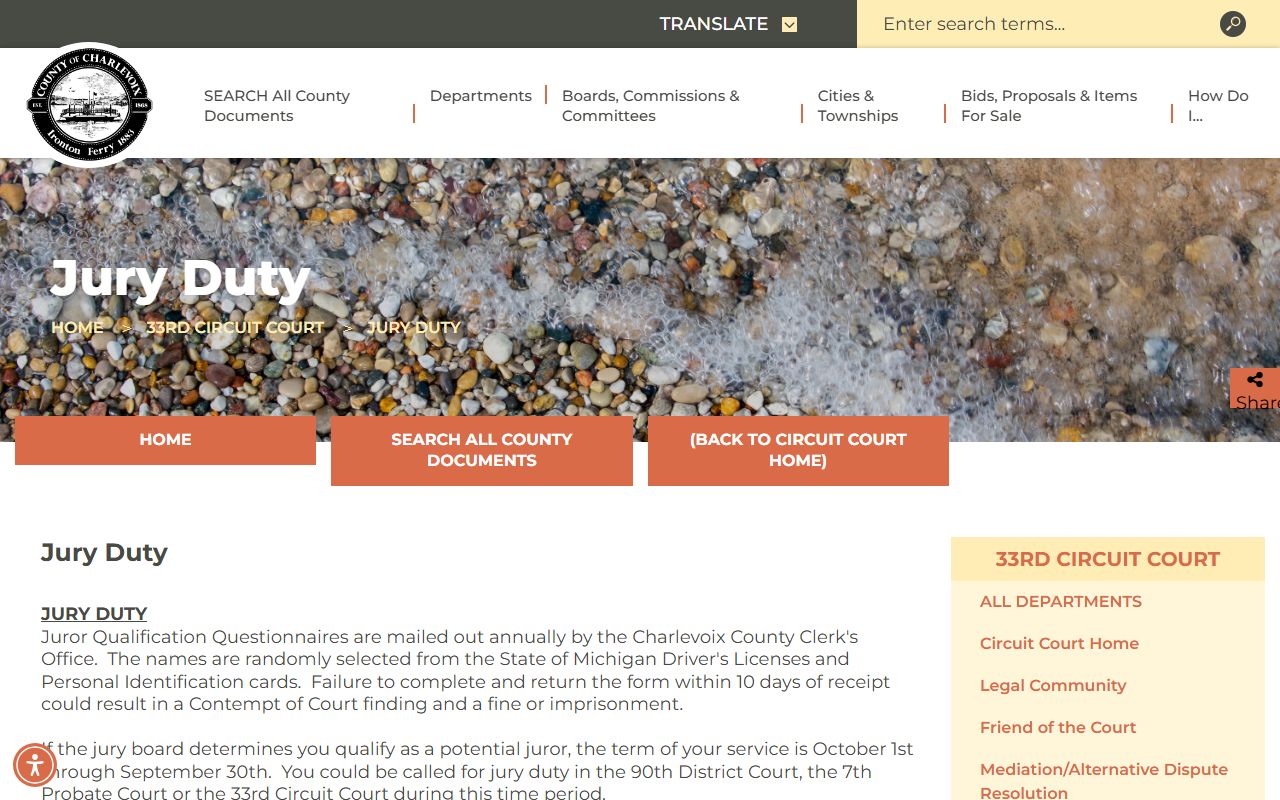
A docket date can change, so confirm a hearing before you drive downtown. The circuit court runs a jury line for people summoned to trial, which is the quickest check for jury-related dates. For anything else, the county routes court questions to a central email and a shared phone line. Both trial courts sit at the same State Street building, so the routing line can point you to the right clerk fast.
The circuit court's jury information page lists the jury line and eligibility notes for trial-related dates.
When you are not sure which court holds your case, the contacts below route the question for you.
33rd Circuit Court
301 State St.
Charlevoix, MI 49720
231-547-7243
When a Charlevoix County Docket Is Missing
Not every docket shows up online. Older cases may never have been scanned, and some family and enforcement matters live in offices rather than the public portal. Friend of the Court, for example, tracks support and custody enforcement dockets on its own schedule. When a search comes up empty, the fallback is a phone call and, if needed, a written request.
The Friend of the Court explains its enforcement work on the county's case management and enforcement page.
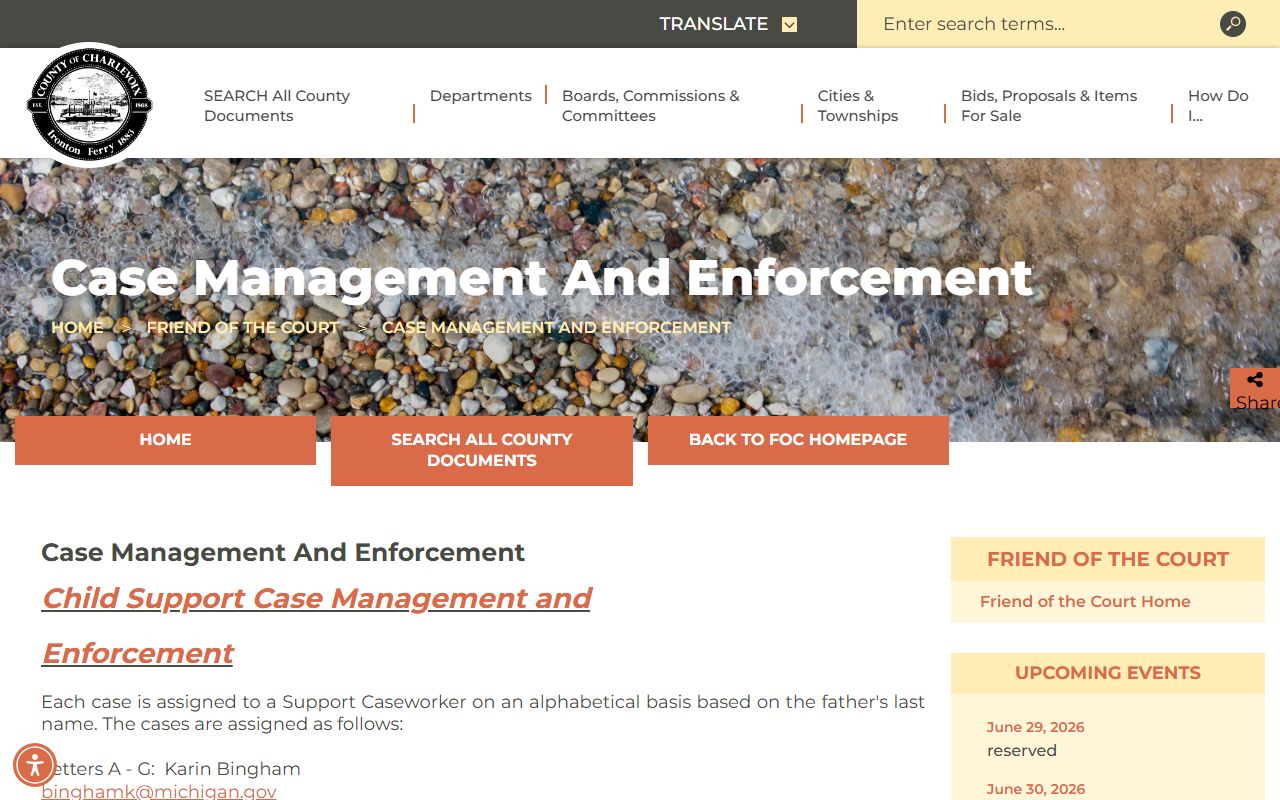
That office handles the family-case dockets that do not appear in the general portal search. For other gaps, work the fallback chain in order.
- Call the court that holds the case and ask staff for the next docket date and case status.
- Ask the County Clerk, the official keeper of circuit court records, to pull an older or non-digitized file.
- File a written records request when a document is not posted, using the correct county FOIA route for the office that holds it.
Court records and FOIA records are not the same channel; the judicial branch is handled under the Michigan Court Rules, while the clerk and sheriff route other requests by subject matter.