
Criminal Court Records in Charlevoix County
A criminal court record is the official case file a court opens when the prosecutor files charges. It holds every paper and order tied to that case. Typical documents include the warrant request, the complaint, the information, arraignment notes, plea forms, motions, hearing orders, and the sentencing order. The county clerk serves as the record keeper for circuit court criminal files, while each court's criminal division tracks the register of actions. The file grows as the case moves, and it stays as the permanent public record once the case closes.
Two trial courts hear criminal cases in Charlevoix County. The 90th District Court handles misdemeanors and the early stages of felony cases, including arraignment and the preliminary examination. The 33rd Circuit Court is the trial court of general jurisdiction and handles felonies and more serious criminal matters. Most cases begin with the prosecuting attorney, who reviews warrant and charging requests before any charge is filed. A closer look at the charges themselves lives in the Charlevoix County arrest and charge records.
How to Search Charlevoix County Criminal Court Records
The county's public search path starts with the countywide document portal hosted at charlevoixcountymi.documents-on-demand.com. The portal offers Any Word, All Words, and Exact Phrase modes plus a date-range filter. For current county files, the portal is the first stop. When a file is not online, the court clerk and the criminal case manager remain the local fallback for older or non-digitized records.
- Open the county document portal and choose a search mode such as Exact Phrase.
- Search by the defendant name or the case number printed on court papers.
- Narrow the results with the date range or a custom start and end date.
- Open the matching file to read the register of actions and the disposition.
- Request a certified copy from the county clerk when a court-ready copy is needed.
Michigan also runs a statewide case-search site at micourt.courts.michigan.gov/case-search. That portal is the backup for statewide court visibility, opinions, and orders across trial courts. It is a client-side app rather than a static form, but it remains the official state fallback when a case does not surface in the county portal.
Stages of a Criminal Case
Most cases begin with the prosecuting attorney. The prosecutor reviews the warrant and charging request from police before any charge reaches a court. The Charlevoix County Prosecuting Attorney office page explains that the office represents the State of Michigan in criminal prosecutions in both circuit and district court.
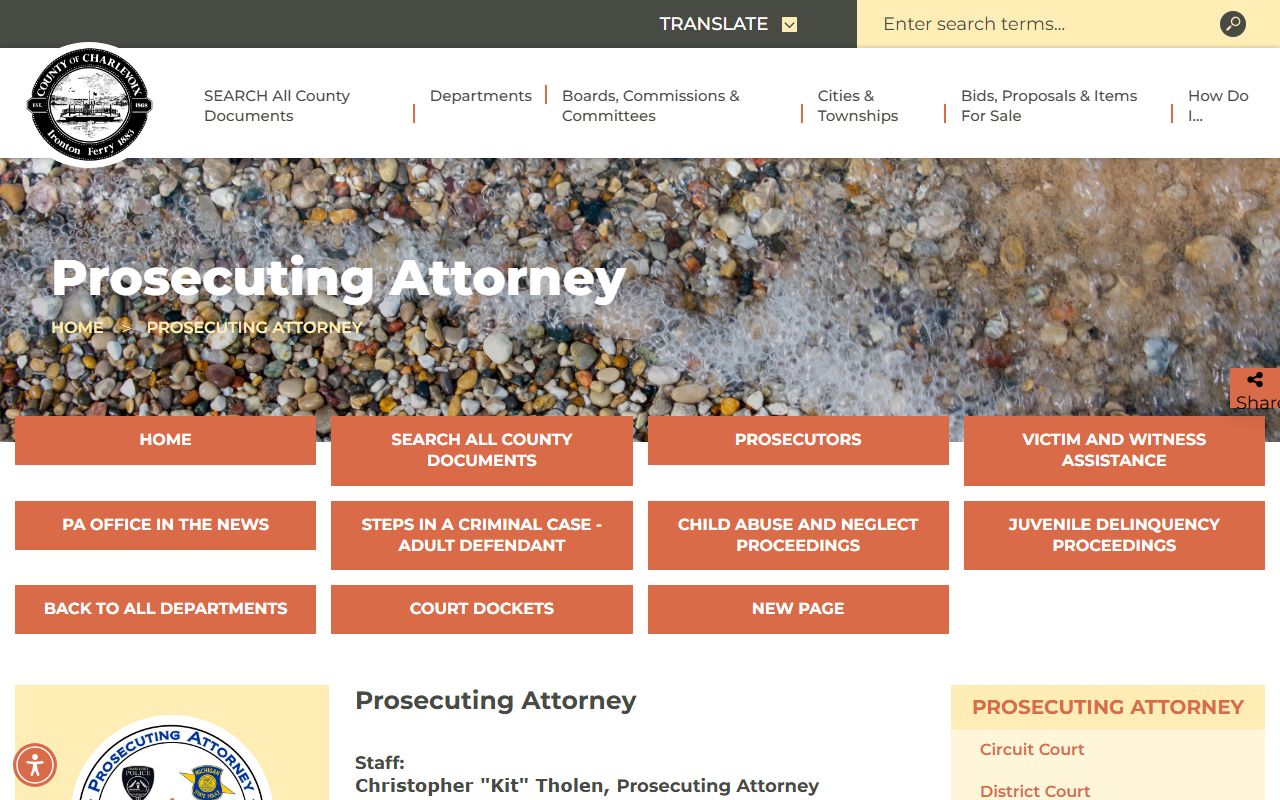
That review sets the whole case in motion, so the earliest entries in a Charlevoix County criminal court record often trace back to the prosecutor's charging decision. Each later step then adds its own layer to the file. The flow below shows how a case moves and where each step lands in the record.
Case flow: Charges Filed › Arraignment › Pretrial / Motions › Plea or Trial › Disposition › Sentencing
| Stage | What Happens |
|---|---|
| Charges Filed | The prosecutor files a complaint. A warrant or summons brings the defendant to court. |
| Arraignment | The first court appearance. The judge reads the charge, sets bond, and takes an initial plea. |
| Pretrial / Motions | Attorneys exchange information, argue motions, and often discuss a plea deal. |
| Plea or Trial | The defendant pleads, or a judge or jury decides guilt at trial. |
| Disposition | The recorded outcome, such as guilty, dismissed, or acquitted. |
| Sentencing | After a conviction, the judge sets the penalty and enters the sentencing order. |
Felonies pass through the district court for the early stages, then move up to the circuit court for trial and sentencing. Note: appeals run from the district court to the circuit court, and from the circuit court to the Michigan Court of Appeals.
What a Charlevoix County Criminal Court Record Shows
A criminal case file follows a standard set of fields under Michigan court rules. The case number leads the file and carries the year filed plus a two-letter case-type suffix, such as CR for criminal. From there, the record names the parties, lists the charges, and tracks every hearing in the register of actions. The prosecutor's case managers help keep these files moving, as shown on the Charlevoix County prosecutor staff page.
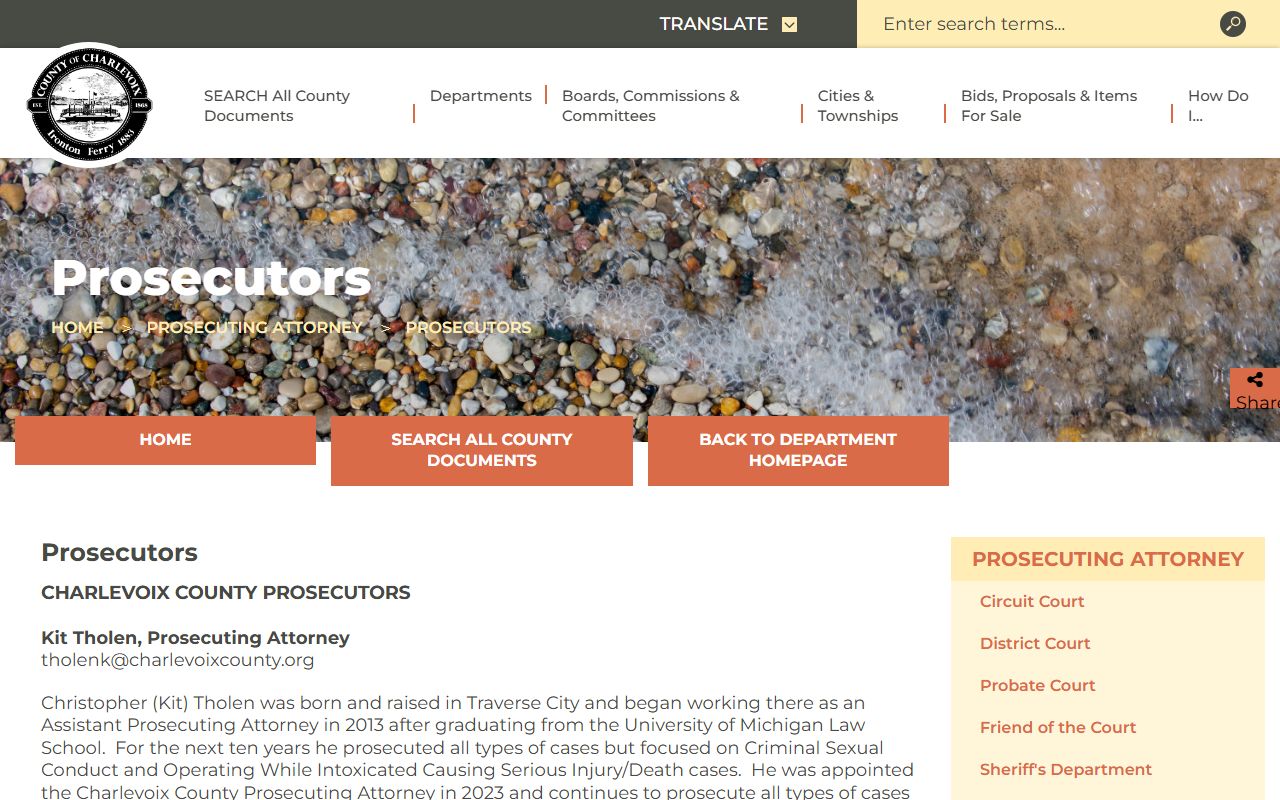
That office assigns separate case managers to felony and misdemeanor matters, which explains why a case file cites specific staff and attorney names. The table below breaks down the core fields a reader will see in a Charlevoix County criminal court record.
| Field | What It Shows |
|---|---|
| Case Number | Unique ID with the year filed and a case-type code such as CR. |
| Defendant | The person charged, listed by name in the case caption. |
| Charges | Each count as filed, with the statute and severity level. |
| Plea | The response entered: guilty, not guilty, or no contest. |
| Disposition | How the case ended, from dismissal to conviction. |
| Sentence | The penalty imposed, such as jail, probation, fines, or restitution. |
Charges vs. Convictions
Being charged is not the same as being convicted. A charge is an accusation that the case still has to prove. A conviction is the finding of guilt that follows a plea or a verdict. A criminal court record can show charges that were later dropped, dismissed, or that ended in acquittal. Reading only the charge, and skipping the disposition, is the most common mistake people make with these files.
| Charge | Conviction | |
|---|---|---|
| Stage | Accusation | Verdict or plea |
| Burden of Proof | Probable cause | Beyond reasonable doubt |
| Can Change | Amended, reduced, or dropped | Final unless appealed |
| Public Record | Yes | Yes |
When a case ends in a conviction, victims gain a set of rights during sentencing and beyond. The Charlevoix County victim and witness assistance page outlines that support, from courtroom orientation to restitution help.
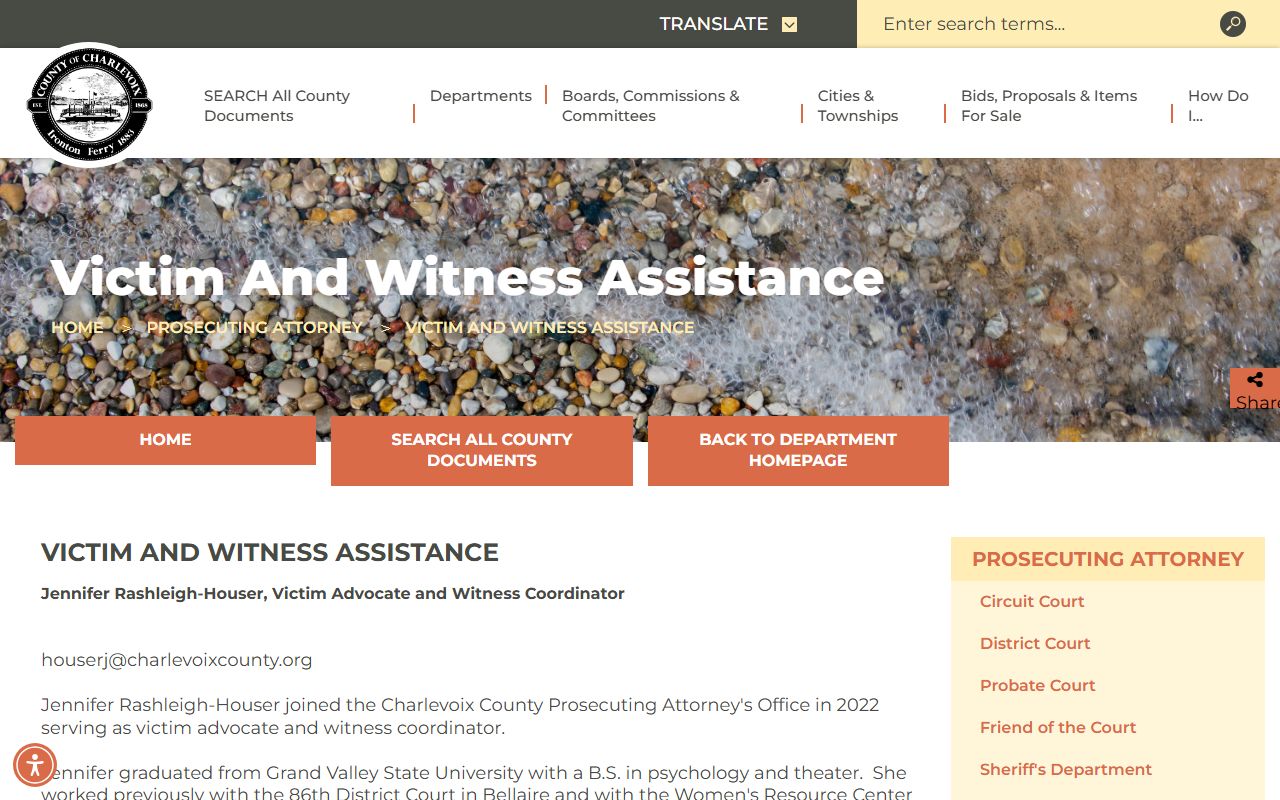
Those victim entries can appear in the case file as restitution orders or no-contact conditions. They are one more reason the disposition, not the opening charge, tells the real story of a Charlevoix County criminal case.
Reading Dispositions and Sentences
The disposition is the line that tells how a case ended. Common terms include guilty, not guilty, dismissed, and no contest, which is a plea that accepts the penalty without admitting fault. Some files use status words like pending, open, disposed, closed, sentenced, or probation. A dismissal can read as with prejudice, meaning it cannot be refiled, or without prejudice, meaning it can. The sentence sits just below the disposition and spells out the penalty.
Sentences in a Charlevoix County criminal court record can list jail or prison time, probation terms, fines, court costs, and restitution to victims. A felony sentence may send a person to a state prison run by the Michigan Department of Corrections. The Michigan Department of Corrections website is the official home for state prisoner information.
When the record shows a prison term, the corrections system, not the court file, tracks where the person is held and the release status. That handoff from the court to corrections is where the sentence in the record turns into custody information.
Finding Prisoners After Sentencing
A criminal court record ends at the sentence, but the custody trail continues. For state prisoners, Michigan runs the Offender Tracking Information System, known as OTIS. The OTIS search page lets anyone look up a state prisoner by name and view custody status. The corrections agency also answers common questions on its frequently asked questions page.
That FAQ page explains parole, sentence terms, and how OTIS records are updated. Some Charlevoix County cases are prosecuted in federal court instead, since the county sits in the Western District of Michigan. Federal charges are handled by the U.S. Attorney's Office for the Western District of Michigan.
Federal case files sit in a separate system from the county and state courts. For local custody, the county jail roster and booking detail live in the Charlevoix County inmate records, which is the right stop for people held before trial or on a county sentence.
Sealed vs. Expunged Records
Two court actions can take a criminal record out of public view, and they work in different ways. A sealed record becomes nonpublic by court order, so it stays in the system but is hidden from ordinary searches. An expunged, or set-aside, conviction is treated as though it was removed from public display where the law allows. Michigan's expungement rules are set by statute, and the process runs through the convicting court rather than a local Charlevoix office.
| Sealed | Expunged | |
|---|---|---|
| Visibility | Hidden from public | Set aside and removed from public display |
| Law Enforcement | Limited access | Very limited access |
| How It Happens | Court order under MCR 8.119 | Application under MCL 780.621 |
| Eligibility | Set by the court on a showing of good cause | Eligible convictions after a waiting period |
Michigan's clean-slate law adds automatic set-asides for some convictions after time passes. To seek an expungement, a person checks eligibility, gathers the convicting court, case number, and conviction details, then files the application with that court.
Public Access to Criminal Court Records
Court records in Michigan are generally public unless a statute, rule, or court order makes them private. Access to court files is governed by court rules, not the ordinary FOIA process that covers other government records. Criminal case files are open for inspection at the courthouse and, for digitized files, through the county portal. A key privacy rule applies to newer filings: documents filed on or after April 1, 2022 should leave out full dates of birth, Social Security numbers, driver's license numbers, and full financial account numbers.
Key Statutes:
MCR 8.119 - Governs access to Michigan court records, public inspection, sealing, and fees.
MCR 1.109 - Defines court records, filing standards, and the PII redaction rules.
MCL 15.231 - Sets Michigan's FOIA policy that public access is the default.
Background Check Considerations
A casual case lookup and a formal background check are not the same thing. Reading a criminal court record for personal interest is fine and free. Using that record to decide on a job, a rental, or credit falls under the federal Fair Credit Reporting Act. Those decisions need a report from a licensed consumer reporting agency that follows FCRA rules. A single county case file is also incomplete, since a person may have cases in other counties or in federal court.
Important: This site is a public resource and is not a consumer reporting agency under the FCRA, so its records cannot be used for employment, tenant, credit, or insurance screening.
Restricted Criminal Court Records in Charlevoix County
Not every criminal file is open to the general public. Juvenile cases are the biggest limit. Under MCL 712A.28, juvenile case records are open only to people with a legitimate interest or by court order. These matters run through the county's family and probate court system rather than the adult criminal docket.
Sealed and expunged files form the second limit. A sealed file is withheld under court order, and an expunged conviction is set aside under MCL 780.621 and the state's clean-slate rules. Certain other items, such as some warrant materials before an arrest and ongoing investigation records, may also stay out of public view for a time. For anything not online, the county clerk and the court criminal division remain the practical route to a certified copy or a record that has not been digitized.